As my cohort the Prince of Kabob introduced in a previous post, one subject that has received much of my ire lately is the recent (though not new) trend of wearing the Palestinian keffiyeh, apparently known to Urban Outfitters (among other retailers) and clueless wearers as a "desert scarf," as a casual clothing accessory. My opinion on the matter began as interested, became conflicted, and eventually has evolved into straight-up anger. When I first began to see people wearing the keffiyeh a couple of years ago-- here and there, not very often-- I would think that it was maybe kind of cool, that maybe they were wearing it as a political statement of being down for the Palestinian cause-- but mostly, I wondered why 21st century San Francisco hipsters were interested in dressing like my deceased great-grandfather and his peers, the keffiyeh being first and foremost just a regular old traditional Arab scarf that farmers and other men used to wear (and still do) to protect their heads from the sun and dirt and sand, which has also evolved into a symbol of Palestinian nationalism and culture. I too have worn the keffiyeh, before this "desert scarf" business came about, both as a symbol of my activism and heritage, and as a means of keeping warm.
Within the past couple of years, though, more and more people-- namely those trend-focused persons whose numerous atrocities in the name of "fashion" I will refrain from detailing at the moment-- have been wearing the keffiyeh, to the point at which it has evolved into a simple, mass-produced, completely inauthentic, trendy piece of clothing that has lost its meaning. I have seen it sold, in many ridiculous colors, by Urban Outfitters (as mentioned before), at army surplus stores, and at shops in trendy neighborhoods.
My issues here are severalfold. First, it makes me laugh that people will pay eighteen dollars (!) for this mass-produced item, when the real thing (which is much more attractive, incidentally) costs much less. Second, it irritates me that people are appropriating this piece of Arab culture without having any idea at all what it represents, or what it means to wear this, or caring to find out, or even knowing its origin-- in essence, being very ignorant about what they choose to put on their bodies. I realize that some non-Arab people do wear this while participating in acts of activism or in support of the cause, and I accept this as long as they educate themselves on the keffiyeh and its meaning and do not fetishize it or the Palestinian/Arab people. If you like the scarf and want to wear it, fine-- just know what it's all about.
Perhaps most of all, it angers me that Arab culture is being commodified and sold by a capitalist and colonialist nation which dares to accuse people of terrorism while unapologetically committing horrible acts of terrorism itself (see previous post for an example). Essentially the commodification of the keffiyeh is an act to discredit the Palestinian cause, making it something to take lightly via the mainstream misappropriation of one of its most recognizable images. That a nation's retailers would promote the production and sale of this imitation item while simultaneously condemning those who have worn it and brought it into the public view as an item of both culture and the cause (Leila Khaled, Arafat, the Palestinian people and most Arabs) is outrageous and hypocritical, but, sadly, not surprising. Why not make a few bucks off the people who we work hard to keep ignorant (Americans) and who we work hard to disenfranchise and destroy (Palestinians, Iraqis, etc...)? It is, after all, the American way!
Yes, I do think it carries much different meaning when an Arab-American wears the scarf as opposed to other types of American. I will bet you that 99 percent of the time, when an Arab wears this scarf, this person will know exactly what it means to do so, whether culturally or as a sign of solidarity, or both. I know that this is not the case with most of those who wear the sweatshop-made, mass-produced imitations in such fun colors as pink and yellow. If somebody likes the appearance of the keffiyeh and chooses to wear it, they are free to do so, but in my opinion should at least be aware of the connotations, and if they do not agree with them, or do not care either way, should not wear the keffiyeh. It troubles me to have my heritage and my people's struggles commodified and trivialized in such a way, and that is exactly what is being done, whether the wearer is aware of it or not.
And for the record, it's not called a freaking "desert scarf."
Monday, March 17, 2008


Saturday, March 15, 2008
The Berkeley Hippie and People's Park
It's not like Berkeley and San Francisco are that much different. In both places you have every kind of person out there ... so diverse and so beautiful, yet my friends in San Francisco insist that I am "Sooo Berkeley!" They always reinforce this by calling me a hippie, labeling me "Berkeley", and insisting that I take a shower ... Who needs showers anyway? I take pride in my Berkeley roots, as I'm from here (and Palestine, of course) born, raised, and now as a scholar. They perpetually label me and even introduce me to new people as a Berkeley hippie! Come on guys ... that's so unfair. (I don't really mind this label, but sometimes they take it to extremes!) I don't have dread locks, I'm not sleeping in the trees (though I support the people sleeping there's cause and give them food or beanies, blankets, etc. when I can), and I do make it to the shower every so often. I'm not saying all hippies are what I just described, but that is the common stereotype.
So yesterday at this event I was a part of planning, we had an excess of food left over and didn't know what to do with it. I said load me up, let's give it to homeless people. I'll leave it in People's Park. They, not knowing much of Berkeley, asked me what People's Park was. People's Park is a park built by and for the people and lits of homeless people reside there and the non-homeless of Berkeley always drop off free food there. So, I went to People's Park carrying trays of food. The homeless people I walked by were talking to me, "Good Morning," "How are you," and other things of this sort. Someone asked if that was free food, and I said "YES! Free Food!" As soon as I set the food on the picnic table, I see this flock of socializing homeless people briskly making their way toward me. I smiled and left before I was trapped in a mob of homeless people. I felt bad that some of the food was soggy due to the rain falling on the bed of my truck where I stored the food on the drive back to Berkeley and People's Park. I was happy that at least the food got there right though. They seemed to appreciate it. Besides, you know what they say ... beggars can't be choosers!
So yesterday at this event I was a part of planning, we had an excess of food left over and didn't know what to do with it. I said load me up, let's give it to homeless people. I'll leave it in People's Park. They, not knowing much of Berkeley, asked me what People's Park was. People's Park is a park built by and for the people and lits of homeless people reside there and the non-homeless of Berkeley always drop off free food there. So, I went to People's Park carrying trays of food. The homeless people I walked by were talking to me, "Good Morning," "How are you," and other things of this sort. Someone asked if that was free food, and I said "YES! Free Food!" As soon as I set the food on the picnic table, I see this flock of socializing homeless people briskly making their way toward me. I smiled and left before I was trapped in a mob of homeless people. I felt bad that some of the food was soggy due to the rain falling on the bed of my truck where I stored the food on the drive back to Berkeley and People's Park. I was happy that at least the food got there right though. They seemed to appreciate it. Besides, you know what they say ... beggars can't be choosers!
Friday, March 7, 2008
Project Rami! FINALE
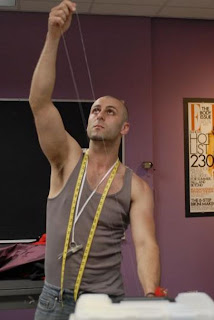
This week we saw the finale of Project Runway, season 4, and thus the end of our weekly television-based dose of one of our favorite wayward Middle Eastern boys, Rami Kashou...
We'll be brief. As you may know by now, Rami came in second this season, following the young and sassy Christian Siriano. There's a lot we could say about this situation: how Rami's collection was actually the most beautiful and diverse and didn't look like Shakespeare on crack, how a woman whose idea of a good accessory is grapefruits implanted under her skin is probably not the best choice for a guest judge, how Michael and Nina-- as experienced and talented as they are-- are still kind of boring, and, ultimately, how this is just television and probably had as much to do with months of producers' planning as it did with the actual designs and designers... but, you know. What we will say is that Christian was not a horrible one to win if Rami couldn't-- his designs have been consistently well-made and innovative, and he exudes potential, and already has a fashion-industry attitude-- and, frankly, seeing him a bit vulnerable and emotional at the end was actually rather nice. (We felt this way about Jeffrey Sebelia last season, too, which made it a little better that he won instead of our fave, Mychael Knight... except his final collection actually was better than Mychael's, but whatever.) Nevertheless, coming in second in a show full of lots of talent is nothing to scoff at, and Rami will still be getting plenty of publicity and attention and hopefully financial support, which is really all he'll need because he is amazingly talented and has already been very successful. And, bottom line, we are so proud that another ambitious young Palestinian man has transcended circumstance and done so well-- and will continue to. That's true reality right there.
We'd like to direct you to Project Runway's "Rate the Runway" page for this last episode, in which you can view, and rate, the looks from each final designer's collection, including Rami's, which was positively gorgeous. And here, you can watch Rami's (highly edited) exit interview, in which he exhibits a lot of poise, class, and graciousness. We'd especially like to ask all those who have been hating on him all season-- and we know there are a lot of you out there-- to watch, because you get a better idea of who Rami really is.
Bottom line, this is television. Even reality shows are not reality. We'll miss watching the show (and Rami) every week, but we also got plenty else to do. Like save the world! We hope you'll join us.
(P.S. Rami, if you ever decide to make anything in our size and price range, give us a call.)
xoxo,
WMEG
We'll be brief. As you may know by now, Rami came in second this season, following the young and sassy Christian Siriano. There's a lot we could say about this situation: how Rami's collection was actually the most beautiful and diverse and didn't look like Shakespeare on crack, how a woman whose idea of a good accessory is grapefruits implanted under her skin is probably not the best choice for a guest judge, how Michael and Nina-- as experienced and talented as they are-- are still kind of boring, and, ultimately, how this is just television and probably had as much to do with months of producers' planning as it did with the actual designs and designers... but, you know. What we will say is that Christian was not a horrible one to win if Rami couldn't-- his designs have been consistently well-made and innovative, and he exudes potential, and already has a fashion-industry attitude-- and, frankly, seeing him a bit vulnerable and emotional at the end was actually rather nice. (We felt this way about Jeffrey Sebelia last season, too, which made it a little better that he won instead of our fave, Mychael Knight... except his final collection actually was better than Mychael's, but whatever.) Nevertheless, coming in second in a show full of lots of talent is nothing to scoff at, and Rami will still be getting plenty of publicity and attention and hopefully financial support, which is really all he'll need because he is amazingly talented and has already been very successful. And, bottom line, we are so proud that another ambitious young Palestinian man has transcended circumstance and done so well-- and will continue to. That's true reality right there.
We'd like to direct you to Project Runway's "Rate the Runway" page for this last episode, in which you can view, and rate, the looks from each final designer's collection, including Rami's, which was positively gorgeous. And here, you can watch Rami's (highly edited) exit interview, in which he exhibits a lot of poise, class, and graciousness. We'd especially like to ask all those who have been hating on him all season-- and we know there are a lot of you out there-- to watch, because you get a better idea of who Rami really is.
Bottom line, this is television. Even reality shows are not reality. We'll miss watching the show (and Rami) every week, but we also got plenty else to do. Like save the world! We hope you'll join us.
(P.S. Rami, if you ever decide to make anything in our size and price range, give us a call.)
xoxo,
WMEG

Subscribe to:
Posts (Atom)